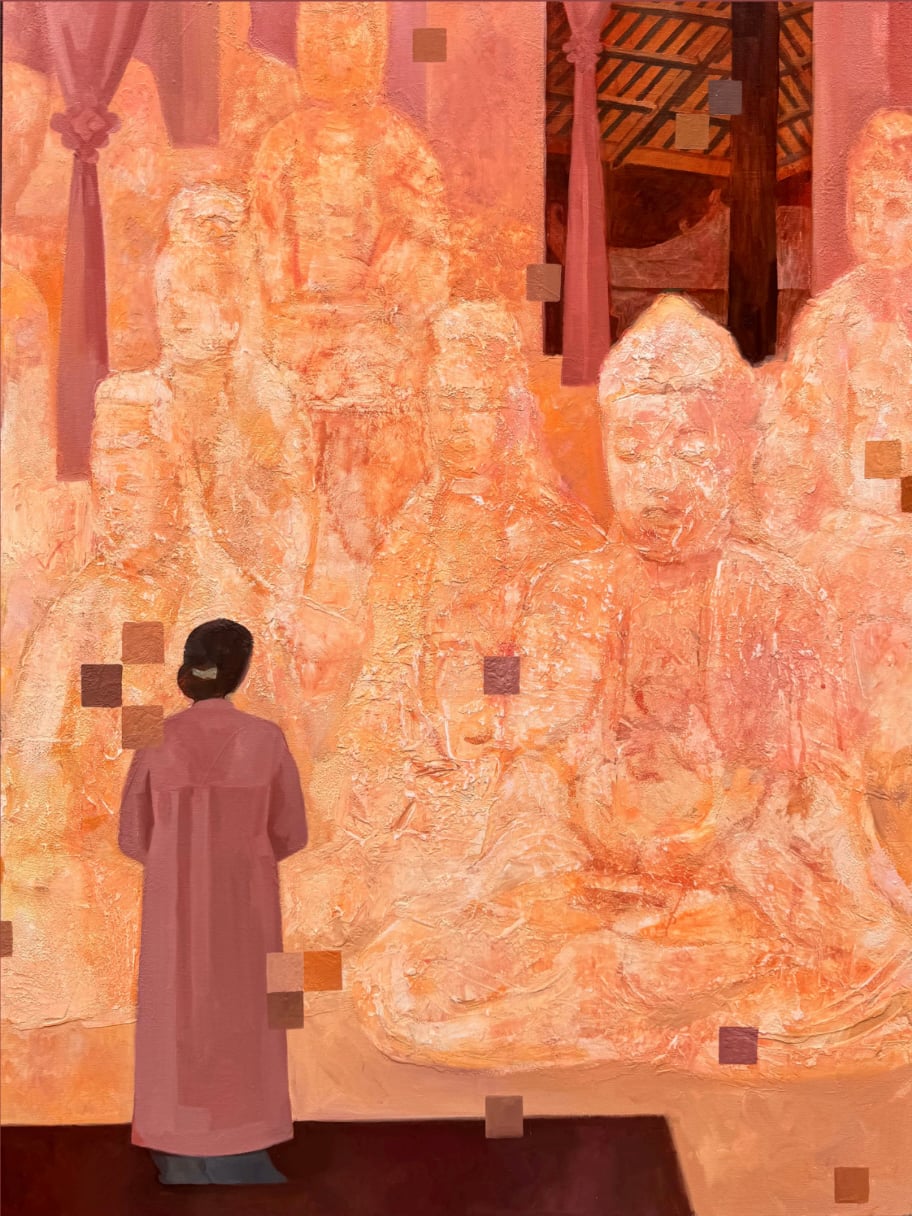
Sublime & Fragile by Hoang Hue Phuong
Press Release
Sublime & Fragile focuses on Hoang Hue Phuong’s sustained investigation of water as an experiential structure, a cultural genealogy, and a historical signifier. Water is not merely a geographical condition of Vietnam, but a foundational structure of perception and affect: soft yet enduring, capable of nurturing all things while quietly eroding them. In the artist’s narrative, water signifies migration, disappearance, forgetting, rupture, and renewal, forming a continuously operative historical dynamic. This exhibition takes “the sublime” and “the fragile” as two poles through which to examine the tension between individual experience and collective history. The sublime refers to grand narratives, political symbols, imperial power, and beliefs in permanence; the fragile points to the vulnerability and instability of the body, emotion, and memory. The artist moves persistently between these positions: under the force of water, monumental symbols collapse, while minor elements and personal memories reveal more resilient modes of existence. The works thus operate in a dual movement—exposing the dissolution of symbolic systems while restoring weight and presence to experiences that are often overlooked.
The exhibition is structured around two principal sections:
I. river & water: A Fluid World and Interchangeable Belonging
The ground floor focuses on multiple manifestations of water—floods, mist, tides, riverbanks, exposed mud after recession, and floating water hyacinths. The artist treats water as a conduit of emotion and time, allowing the works to oscillate between stability and instability. Here, water functions simultaneously as geographic reality and psychological space. It responds to the artist’s childhood marked by repeated relocation, as well as to her diasporic condition in the United States, linking individual displacement to Vietnam’s collective vulnerability shaped by war, modernization, and natural disaster. Within these works, water emerges as a silent structural force: it can erase temples, cities, and memory, yet at moments close to disappearance it allows fragile forms of life—such as water hyacinths and riverside plants—to briefly bloom. The artist advances a crucial proposition here: fragility does not necessarily imply weakness; it may constitute the most enduring and truthful form of persistence.
II. power & decay: Symbolization, Disintegration, and Ruination
The upper level turns toward a critical examination of history, power, and imagery. Emperors, empresses, ritual figures, and symbols of force appear as pixels, damaged lacquer surfaces, blurred lines, and fragmented images. Rather than reconstructing or judging history, the artist reveals how images deform over time—filtered through perception, mediation, and repeated viewing—gradually drifting away from any presumed point of origin. The presence of elephant bones and elephant tombs further intensifies this sense of dissolution. Once emblematic of imperial strength and authority, these figures now persist only as skeletal remnants, material residues left by historical erosion. Pixelated royal portraits point toward a contemporary condition: in the age of hyperreality (Baudrillard), images no longer represent reality but actively constitute it. Symbols of power thus appear simultaneously sacred and fragile, monumental and illusory.
Between the Sublime and the Fragile
Sublime & Fragile does not ask viewers to adopt a fixed position; instead, it invites them to observe how symbols and forms of life coexist within a constantly shifting world. What the exhibition offers is not a singular narrative, but a mode of viewing in flux: • empire and power are not absolute, • history is never complete, • personal memory is always fragmentary, • and fragile things may become the most enduring traces. Water functions as both medium and metaphor throughout the exhibition: it supports images and washes them away; it preserves memory and removes it; it constructs history and simultaneously dismantles it. Within this cyclical process, the sublime and the fragile are redefined—not as opposites, but as coexisting conditions, revealing one of the most accurate states of contemporary existence.